BatteryMIS Logo
AI Integrated Platform
BatteryMIS - Engineering Platform
v2.0
Not saved yet
Live
100%

🎯 Project Requirements & Targets MASTER INPUT - feeds all modules

Define all project targets here first. All Engineering tabs, TVR, DVP Intake and Battery Testing auto-read from this sheet.

🔗 Every module reads from this sheet. Fill targets before using other tabs - calculations and checks auto-update.
① Project Setup
📁 Project Information
e.g. EU, US, CN, IN, JP - drives certification requirements
🚗 Vehicle / Application Type MASTER
🏍️
2-Wheeler
E-bike / Moto
🚗
4-Wheeler
Passenger EV
🚌
Bus
Transit
🚛
Truck / HCV
Commercial
🏭
Industrial / AGV
Forklift / Crane
🌾
Ag Tractor
Farming
⚙️
Other / Custom
Marine / Rail
② Energy & Capacity
🔋 Pack Energy Targets
Minimum gross pack energy required
1.0 = 0–100% · 0.8 = 10–90% SoC window
⚡ Energy Density
Pack-level target (not cell-level)
System weight constraint
Packaging envelope constraint
🔌 Voltage Architecture
Min pack terminal voltage at full discharge
Max pack terminal voltage at full charge
③ Electrical Performance
⚡ Discharge Power
Sustained peak for 10 min, e.g. hill climb
🔌 Charging Performance
Cell datasheet limit - flows to Charging tab
④ Thermal System
🌡️ Operating Temperature
BMS protection threshold
Max ΔT across pack at steady state
💧 Cooling System
Pre-conditioning / cold climate heating
🌡️ Storage Conditions
Typically 30% per UN 38.3 transport
⑤ Environmental & Safety
🌍 Environmental Requirements
Sets test severity for water ingress testing
Max operating altitude - affects HV creepage clearance
Test Requirements - blank = not specified
Test Type Requirement / Spec
Vibration
Salt Fog / Corrosion
Shock
Drop / Crush
🎯 Extended Check Targets ← thresholds used in Target vs Results · Extended Checks table
Edit these limits to match your project specification. They feed directly into the Extended Checks pass/fail table.
Resistance check - Pack IR at BoL must be ≤ this
DCIR check - EoL/BoL IR ratio must be ≤ this
DCIR check - voltage drop at −10°C/20%SoC/I_peak
BMS check - V_max − V_min must be ≥ this
Precharge check - RC time constant ≤ this
HV Safety - IEC 6469-1 voltage class for your pack
Charging check - T_chg_hi − T_chg_lo must be ≥ this
Energy check - SoC headroom at 90%SoC regen point
⚠️ HV Safety Requirements
Per IEC 60664-1 - auto-calculated from V_max
GB 38031 / UN GTR 20: ≥5 min occupant warning
📜 Certification Requirements
Enter applicable standards manually. Leave blank if not yet determined - blank fields are treated as pass in compliance checks.
Primary safety standard(s) for your markets
⑥ Lifetime & Reliability
📈 Cycle & Calendar Life
🔩 Durability & BMS
BMS target SoC accuracy RMS
⑦ Business & Cost
💼 Cost Targets
System-level pack cost including BMS, housing, cooling
⑧ Target Compliance Overview
✅ Target Compliance Overview

🔬 Cell Inputs Configuration

All cell parameters propagate automatically to Energy, Voltage, Thermal, Resistance, and all other modules.

Cell Parameters Auto-propagates everywhere →
DCIR at 25°C, 50% SoC, 1C pulse
📄 Cell Datasheet Auto-Extract
📂 Upload cell datasheet (PDF or TXT) - auto-extracts key parameters
Supports: Capacity, Voltage, IR, Mass. Review extracted values before continuing.
📈 OCV–SoC - All Temperatures (V)
📂 Upload CSV
DoD Target: (0–1, links from Energy tab)
SoC
0°C
25°C
(%)
°C
(fixed)
(fixed)
°C
0
10
20
30
50
70
80
90
95
100
Pack Architecture
Derived Pack Specifications

Target vs Result

Chemistry Reference

📈 OCV–SoC Curve
━ T_min ━ 0°C ━ 25°C ━ T_max ━ DoD window ⬛ outside DoD

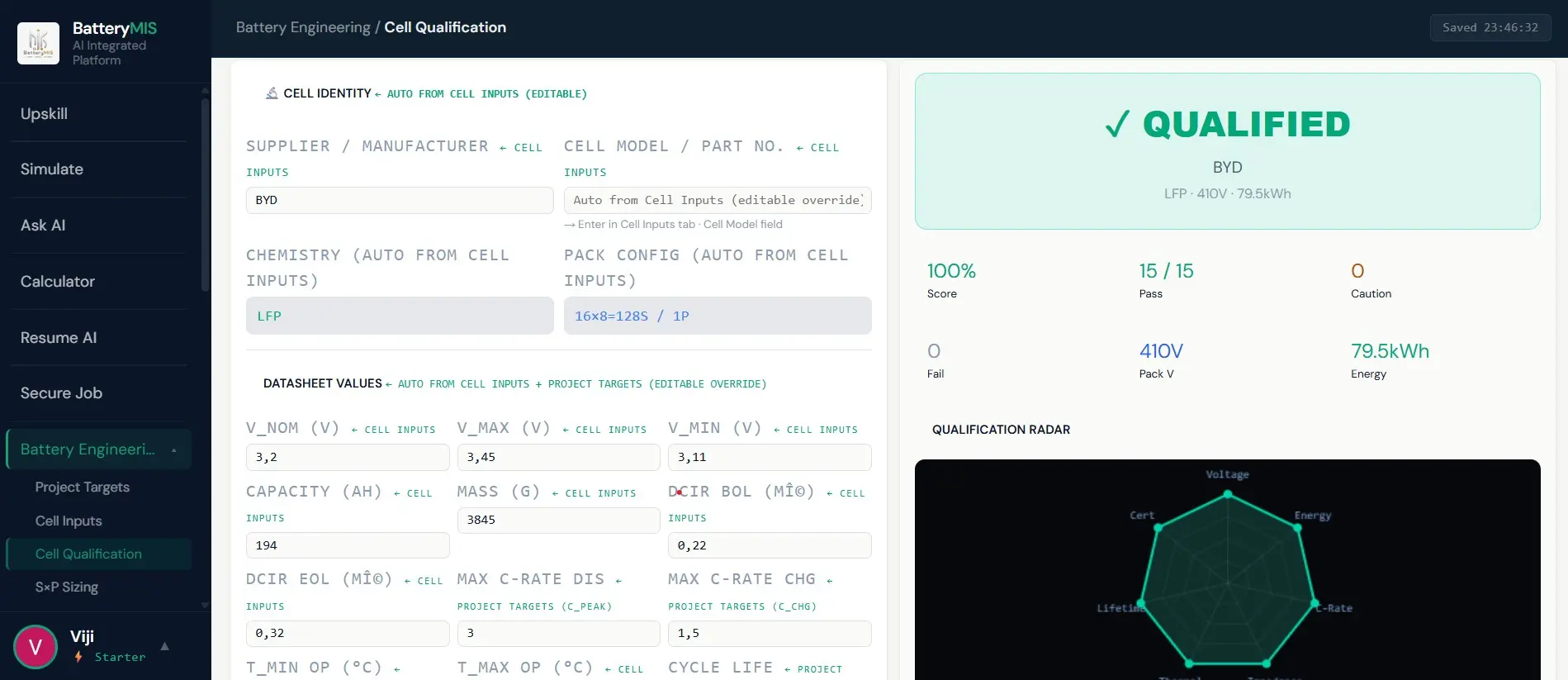
🏆 Cell Qualification Scorecard

OEM gate-check: auto-validates supplier cell datasheet values against your project targets. 16 checks across voltage, energy, C-rate, impedance, thermal, lifetime and certification. Go/No-Go verdict.

🔗 Auto-reads Cell Inputs + Project Targets · All values editable for override · Export to CSV for DVP package
⏳ Loading qualification scorecard…

⚙️ S×P Sizing Calculator

Evaluates all valid configurations against constraint matrix. Click row to apply to Cell Inputs.

🔗 Auto-reads Cell Inputs + Project Targets. Click any result row to push config to Cell Inputs tab.
⏳ Fill Cell Inputs and Project Targets first, then open this tab.

🌡️ DCIR Map - Cell & Pack Resistance vs T & SoC

Upload cell supplier Excel or enter manually. 25°C/50%SoC baseline auto-pushes to Cell Inputs.

🔗 Uploads push baseline IR to Cell Inputs · Pack IR from S×P config · Hover heatmap cells for details
⏳ Upload DCIR datasheet Excel or use manual table entry below.

📉 Temperature Derating - Power vs T_cell

Discharge & charge derating curves. Auto-reads P_peak and T_cell_max from Project Targets.

🔗 Auto-reads P_peak · T_cell_max · chemistry from Project Targets and Cell Inputs
⏳ Loading derating curves…

🔌 Fuse & Circuit Protection Selector

Auto-recommends main fuse, MSD rating, voltage class and type. IEC 60269-4 · SAE J1495 · ISO 8820.

🔗 Auto-reads I_peak (P_peak÷V_nom) · I_cont · V_max · I_sc from project
⏳ Loading fuse selector…

🔋 Usable Energy & Derating

Cell inputs auto-pulled from Cell Inputs tab. Target indicators update vs Project Targets.

🔗 Cell data from Cell Inputs · Targets from Project Targets
Derating Factors
E_usable = E_gross × DoD × Î·_sys × f_BOL × f_balance × f_voltage × f_design × f_temp
From Project Targets DoD field · 1.0=full window, 0.8=10–90% SoC · adjusts OCV chart window
Typical: 0.97–0.99. From datasheet at 1/3C @25°C.
5 mV imbalance, 12 mV/%SoC → typical 0.988
12 mV/%SoC, ±7 mV accuracy → typical 0.988
@25°C=0.98 · @10°C=0.97 · @−15°C=0.95
1.0 if TMS active. Apply only for unconditioned packs.
Energy Results vs Targets
Factor Loss Waterfall

⚡ Voltage Window & Configuration

System voltage validated against Project Target limits. Highlights valid S configurations.

🔗 V_min/V_max system targets from Project Targets · Cell voltage from Cell Inputs
Voltage Inputs (auto-filled from Cell tab)
Number of cell groups (stacks) in series. Min value: V_sys_min / (cells_per_stack × V_cell_max). From: target voltage window & cell voltage limits.
Max value: V_sys_max / (cells_per_stack × V_cell_min). Practical limit: pack physical size constraint.
Validated Configuration
Voltage Window
Strings Configuration Matrix - V range per S count

🌊 Current & Power Analysis

Load profile inputs. Ambient temperature adjustable - results update live.

🔗 Pack V_nom from Cell tab · Peak power target from Project Targets
Load Profile Inputs
P_total = P_hydraulic/(η_m·η_inv) + P_traction/(η_m·η_inv) + P_TMS + P_aux/η_dcdc I_bat = P_total / V_nom | C-rate = I / Q_Ah
25°C
Main Drive
ℹ️ Ambient temperature affects results: each ±10°C change modifies power demand by ~5–8% through TMS load and efficiency changes. Cold ambient increases TMS heating; hot increases compressor/cooling load.
Traction
Auxiliary & iTMS Cooling
Any other HV consumers: work lights, attachments, compressor, pump, etc.
Current & Power Results
Power Breakdown
━ T_min ━ 0°C ━ 25°C ━ T_max
Efficiency Map - Target vs Result
Temperature Sensitivity Matrix

🌡️ Thermal Management System (TMS)

Pack config auto-selected from Cell Inputs. Load case can be customised or upload a duty cycle CSV.

🔗 Pack mass/Cp from Cell tab · Current from Power tab · Targets from Project Targets
Load Case Selection
📂 Click to upload duty cycle CSV
Columns: time_s, power_kW
TMS Inputs (Auto from Cell tab where noted)
Heat transfer coeff cell→housing→air. From temp. limits sheet: 30 W/K
50% glycol–water mix: 3400 J/kg·K
Heater / Pre-conditioning
TMS Results
Thermal Balance
TMS Set-Point Logic (standard)
Cooling Plate Pressure Drop Calculator
Re = ρvD/μ | If Re<2300: laminar (f=64/Re) | Else turbulent (Swamee-Jain) ΔP = f × (L/D) × Ïv²/2 [Pa] → convert to mbar ÷100
Total coolant path length in plate
Cooling System Properties

🔌 Charging Analysis

🔗 OCV points from Cell tab · Charge power targets from Project Targets
Charging Inputs
V_avg = S × (OCV_10 + OCV_90)/2 I_charge = P_charger / V_avg C-rate = I / Q_Ah t_charge = E_usable / P_charger
Set in Project Targets → Charging · auto-linked here
Charge Results vs Targets
Charge Time vs Charger Power
Charge Time vs Charger Power - Table

📈 Lifecycle, SoH & Calendar Life

🔗 Cycle/year targets from Project Targets · Gross energy from Cell tab · P_avg from Drive Cycle tab
Lifecycle Inputs
SoH(n) = 1 − (n/N_life) × (1 − SoH_EoL) Life_years = min(N_cycles / cycles_per_year, calendar_target) E_net = E_usable × (1 + η_regen × f_regen) [regen credit] Autonomy = E_net × SoH / P_avg_net [hours] P_avg_net = P_avg × (1 − η_regen × f_regen) [net demand]
Average traction + auxiliary load kW before regen credit. For excavator ~8–15kW avg. Upload duty cycle in Drive Cycle tab for accuracy.
% of consumed energy recovered via regenerative braking. Off-highway: 0–15%. Road vehicles: 15–35%. Excavator boom-down: up to 25%.
Round-trip efficiency of regen path: motor→inverter→battery. Typical 80–90%.
Used to convert cycle life → operating hours. Full workshift = 8–10h.
Optimal for calendar life: 30–60%
Lifecycle Results vs Targets
SoH & Autonomy
━ SoH% ━ Autonomy (h) - - EoL target - - Autonomy target
SoH Trajectory Table

🔬 Pack Resistance - Component Build-Up

Technical resistance model built from sub-component parameters, contact types, and geometry. Based on standard resistance calculation methodology.

Cell Tab Contact Resistance Model
R_contact = ρ/(A×n) × Kc × Ks × Kp × Kw × (1 + α×ΔT) where: Kc=constriction, Ks=surface, Kp=porosity, Kw=weld efficiency
Busbar
Contact Factors
1.5–3.0 (typical: 2 = welded/pressed)
1=bare, 1.5=plated
1.1–1.3 typical
0.01–0.05 (good weld = 0.03)
Pack Architecture Counts (← from Cell tab)
Pack Resistance Build-Up
Additional HV Path Components
Add any combination of: contactor, fuse, wiring harness, connector, shunt, precharge resistor. Values will be added to total pack resistance.
Extra Components Total
BoL vs EoL Comparison
Material Conductivity Reference

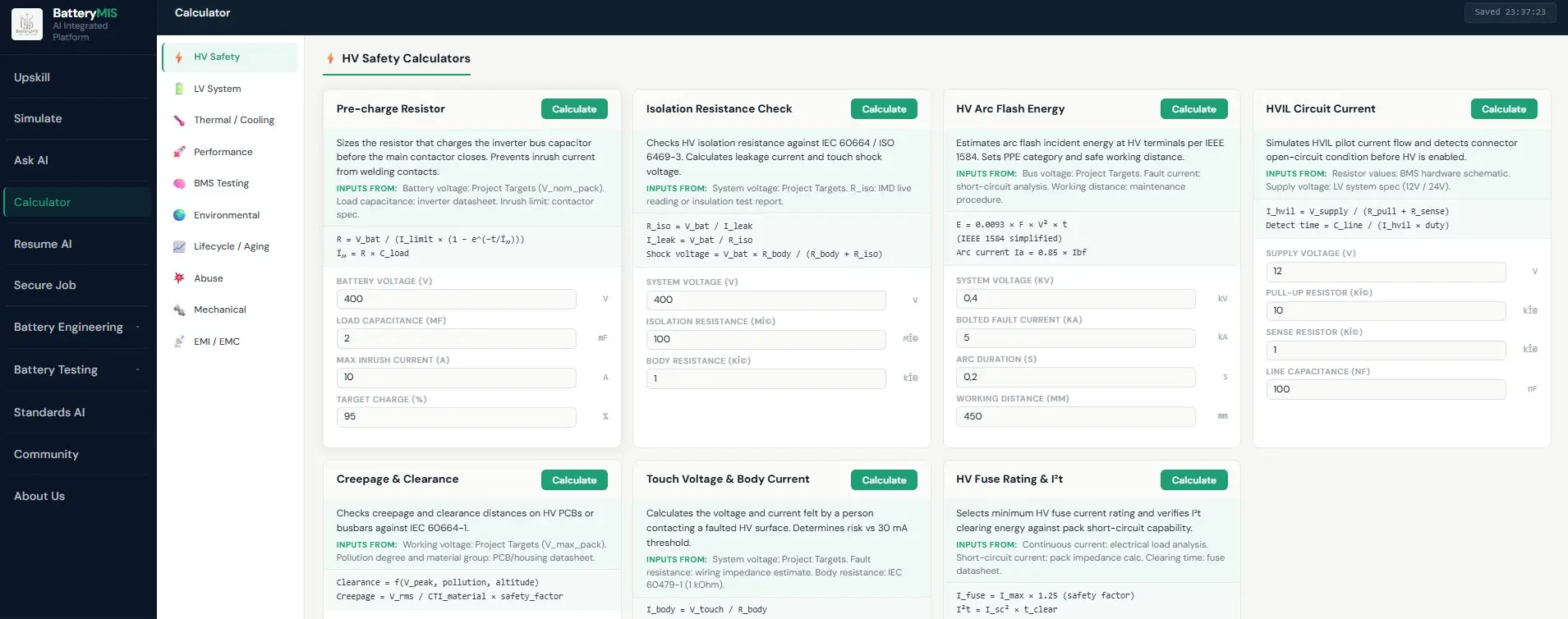
⚙️ Precharge Resistor Calculation

Selects resistor based on capacitance, pack voltage, time, current limit, and leakage - outputs energy rating and contactor inrush check.

🔗 Battery voltage from Cell tab
Precharge Inputs
Ï„ = t_pre / n → R = Ï„ / C (by time constant) R = V_bat / I_max (by peak current limit) R = (1−α)·V_bat / I_leak (by leakage) R_sel = max(R_by_time, R_by_Imax, R_by_leak) Vc(t) = V_bat × (1 − e^(−t/Ï„)) I_main_inrush = (V_bat − Vc_final) / R_main_total
Total DC bus capacitance of connected load (inverter, DC-DC, motor drive). Typical: 0.5–5 mF.
n=5 → 99.3% of V_bat. n=3 → 95%. IEC 60947 standard uses n=5.
Close main contactor when Vc ≥ α × V_bat. 0.95–0.99 typical.
Sets minimum R = V_bat/I_max. Protects precharge resistor from overcurrent. Set 0 to ignore this constraint.
Maximum allowable leakage through precharge path (isolation monitoring concern).
Total series resistance when main contactor closes: contactor Rce + wiring resistance. Typical 1–5 mΩ. Used for inrush calculation at contactor close.
From contactor datasheet. e.g. Sensata AMETEK: 500A, Tyco EV200: 700A, TE Kilovac: 700A.
Engineering target for inrush current when main contactor closes. Typical: 10–50A. Rule of thumb: <10% of contactor I_rated (e.g. 50A for 500A contactor). Lower = better for contactor life. Depends on capacitor charge level at close, bus capacitance, and cable resistance.
Max energy allowed at contactor close: E = ½CV²_delta. Keep below contact rating. Typical 0.01–0.1J. Set 0 to ignore.
Recommended ≥1.5× E_res for resistor pulse rating.
Precharge Results
Capacitor Charge Curve (0 to t_end)
Show 0 → 3s
🟢 Voltage curve · 🟡 α threshold · 🟠 t_pre marker · 🔵 I_min voltage limit

🗺️ Battery & ePT Power Map

Define operating modes with power and duration. Chart shows envelope + time profile vs targets.

🔗 Values auto-filled from Targets & Cell - edit any field to override
⚡ Voltage Window
🔋 Power Modes
Mode
kW
Time (s)
● Cont. Discharge
● Peak Discharge
● DC Charge
● AC Charge
📐 Limits
I×V hyperbola on P vs V chart
🎯 Targets
Excavator: 30s · Bus: 60s · Truck: 120s · Industrial: 300s
📊 vs Target
⚙️ Operating Point
Power Envelope
ePT Efficiency Breakdown
📋 Engineering Result - Power Envelope Analysis

🛡️ Safety, Fusing & Protection Sizing

🔗 Pack voltage and current from Cell tab · Application from Project Targets · Regulatory Compliance moved to the Standards top-level tab
Protection Sizing
I_fuse ≥ 1.25 × I_peak_30s R_precharge → see Precharge tab I_sc = V_pack / (R_int + R_ext_min) A_cable = 2ρL × I_cont / V_drop
Fusing & Cable Results
Protection Chart
📜 Applicable Standards ← filtered from Standards database by application

🚗 Drive Cycle / Work Cycle Analysis

Upload CSV or enter points manually. Live chart shows Time vs Power / Voltage / Current.

🔗 Results auto-feed → Current tab (avg power) · Lifecycle tab (P_avg) · Thermal tab (heat load)
Upload Work Cycle
CSV format: time_s, power_kW (one row per timestep) Optional col 3: voltage_V or speed_kmh
📊 Upload work cycle Excel or CSV
Col A=time_s · Col B=power_kW · Col C=voltage_V (optional)
Manual Entry - Time vs Power
Enter cycle points below. Click + to add rows. Chart updates live.
Quick stats
Time-weighted avg from cycle data
📊 Cycle Analysis Results
🔗 Upload file or add manual points

Upload a CSV or add points above

Energy Budget
Drive Cycle
━ Power (kW) ━ Pack Voltage (V) ━ Current (A) - - P_avg target
🌡️ Thermal Rise Analysis - Drive Cycle Linked
🔗 Waiting for cycle data
Temperature rise is computed at every drive cycle timestep using cell-level I²R heat generation, thermal mass, TMS cooling capacity, and ambient conditions. Adjust inputs below and click Run Thermal Simulation.
Cell Inputs Thermal
Starting temp at t=0
Surrounding environment
m×Cp - total heat capacity. Auto-fills from Cell tab.
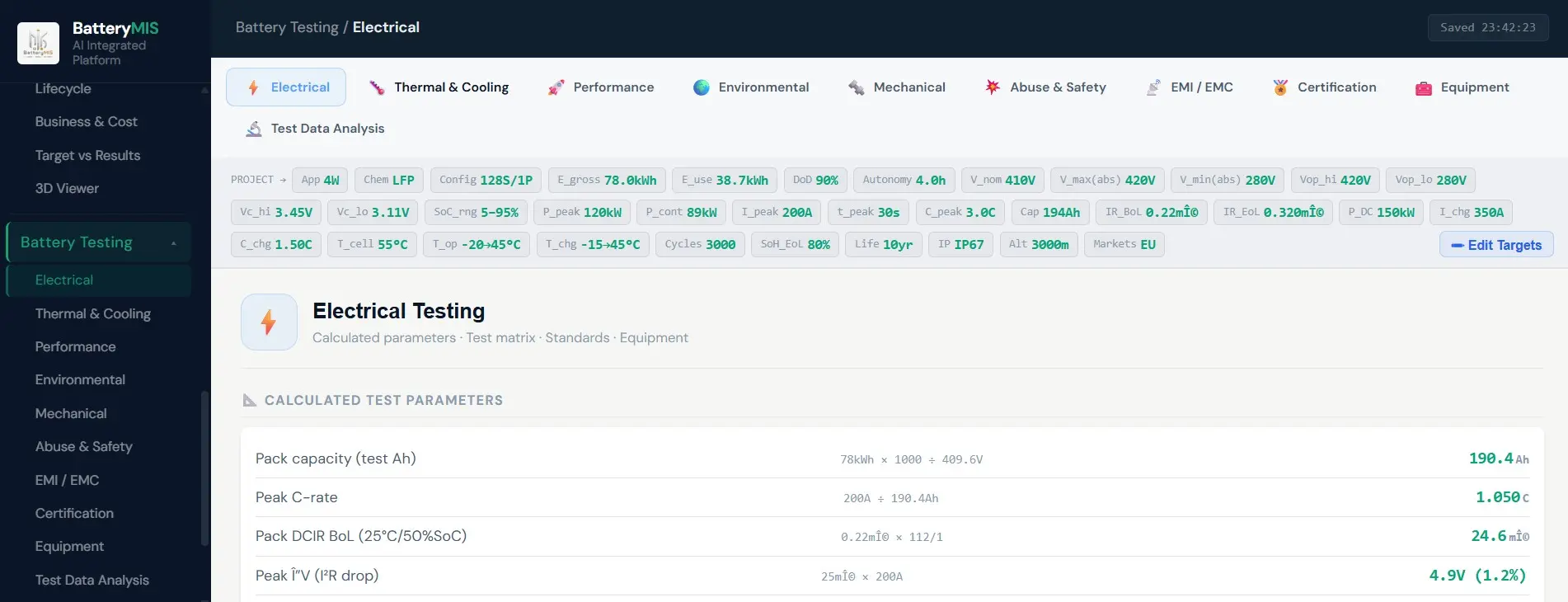
Pack IR = c_ir_bol × S / P (mΩ). Auto-fills from Cell tab. e.g. 0.22 × 112 = 24.6 mΩ
TMS Cooling System
Active coolant flow when TMS running
Temperature of coolant entering pack
Housing-to-air natural convection coefficient
TMS turns ON when cell temp exceeds this
TMS turns OFF when cell temp drops below this (hysteresis)
Limits & Thresholds
BMS begins power derating above this
Hard shutdown threshold
Onset of thermal runaway - critical limit

🧠 BMS Design & Specification

BMS parameters, algorithms, fault thresholds, communication. Linked to Cell, Safety, and Lifecycle tabs.

🔗 Fault thresholds link to Cell tab V/T limits · CC-CV links to Charging tab
Measurement & Sensing
Auto-filled: V_max (${S.c_vmax||3.65}V) − V_min (${S.c_vmin||2.0}V) = operating window. Used to size ADC resolution.
Typical: ±3mV. Affects f_voltage derating.
±1°C typical for NTC @-15 to 60°C
<1% required for good SoC accuracy
Fault Thresholds (← auto-linked from Cell tab)
← From Cell V_max. Add 10–30mV safety margin.
← From Cell V_min + 0.5V margin recommended
← From Target T_cell_max
← From Target T_op_min
← 1.1× max continuous current
Algorithms & SoX
2% at 0–35°C, 3% outside - industry standard
Start balancing when cell Vmax−Vmin > threshold
Communication
CC-CV Charge Profile
CC phase: charge at constant I_cc until V_max reached CV phase: hold V_max, taper until I < I_cutoff t_charge ≈ E_usable / (I_cc × V_avg) + CV tail
Typically C/10 (10% of CC current)

🔩 Busbar Design - CSA, Creepage & Clearance

Busbar cross-section, current density, IEC 60664 creepage and clearance - with pass/fail decision for each check.

🔗 Pack voltage from Cell tab · Max current from Current tab · Temperature rise from Thermal tab
① Busbar Geometry & Material
R = ρ × L / (W × T) × (1 + α×ΔT) J = I / (W×T) [A/mm²] → must be ≤ J_limit ΔT_rise = I² × R / (surface × h_conv)
ΔT = T_busbar_max − T_ambient. Standard: 40°C Cu, 30°C Al (IEC 61439).
Working voltage - determines IEC 60664 creepage/clearance class.
② Creepage & Clearance Inputs IEC 60664-1
Measured physical creepage path on your PCB/busbar design.
Measured physical air gap between conductors at different potential.
Calculated Values
✅ Design Validation - PASS / FAIL
📐 IEC 60664-1 Quick Reference
PD2, OV Cat III - most common EV battery application
Voltage (V)Creepage (mm)Clearance (mm)
≤ 500.80.4
≤ 1501.40.7
≤ 3002.51.5
≤ 6005.03.0
≤ 10008.06.0
Current Density J limits (IEC 61439)
CoolingCu (A/mm²)Al (A/mm²)
Natural convection≤ 3≤ 2
Forced air≤ 5≤ 3
Liquid cooled≤ 8≤ 5

📊 Project Data Hub & Gap Analysis

Upload data, mark availability, and see which calculations need more inputs. All uploaded data auto-populates connected tabs.

🔗 All data uploaded here flows directly into Cell, Energy, Thermal, BMS, Resistance, Lifecycle and Charging tabs automatically.
🔬 Cell Data
Cell Datasheet (V, Ah, IR, Cp) Required
📂 Upload PDF/TXT datasheet → auto-extract to Cell tab
← Feeds: Cell Inputs tab (V_nom, V_max, V_min, Ah, mass, IR)
Full OCV–SoC Curve (10+ points) Required
📂 Upload OCV–SoC CSV (soc%, ocv_V) → auto-fills OCV table in Cell tab
← Feeds: Charging tab V_avg, BMS CC-CV profile, Energy derating
DCIR vs SoC/Temperature Map Required
📂 Upload DCIR CSV (temp°C, soc%, dcir_mΩ) → fills resistance map
← Feeds: Resistance tab, BMS SoP calculation, Thermal heat load
Capacity vs C-rate (Peukert Curve) Required
📂 Upload CSV (crate, capacity_Ah) → Peukert derating
← Feeds: Energy derating f_design, Lifecycle autonomy at high C-rate
Capacity Fade Curve (SoH vs Cycles) Required
📂 Upload CSV (cycles, soh_percent) → SoH trajectory
← Feeds: Lifecycle tab SoH trajectory, Autonomy @5yr/10yr
🌡️ Thermal Data
Drive / Work Cycle Duty Profile Required
📂 Upload CSV (time_s, power_kW) → avg/peak power → TMS sizing
← Feeds: Current tab P_avg, Thermal tab heat load, Power Map
Cooling Plate Pressure Drop Curve Optional
← Feeds: Thermal tab ΔP check. Use Thermal tab calculator if not available.
⚡ Electrical Data
CC-CV Charge Profile Required
📂 Upload CC-CV profile CSV (time_s, current_A, voltage_V)
← Feeds: Charging tab, BMS CC-CV section, Thermal charge heat load
HV Electrical Architecture Diagram Required
📂 Upload HV architecture image or PDF
Precharge Design (R, C values) Required
← Enter in Precharge tab - R, C, α, I_max automatically calculated
🧠 BMS Data
SoC Estimation Algorithm Required
← Feeds: BMS tab algorithm selection + expected accuracy
SoH Estimation Model Required
← Feeds: Lifecycle SoH trajectory, BMS tab
SoP (State of Power) Calculation Optional
← Feeds: Power map limits, Current tab derating factors
Cell Balancing Strategy & Energy Required
← Feeds: Energy tab f_balance factor, Usable energy calc
Fault Thresholds (OV/UV/OT/OC) Required
← Auto-linked from Cell tab V_max/V_min + Temperature targets
📦 Pack Design
Pack CAD / Space Claim Required
📂 Upload STEP/STL/image → view in 3D Viewer tab
Busbar Design (CSA, creepage) Required
← Calculate in Busbar tab. Enter geometry below to auto-calculate.
Thermal Resistance Network (Rth) Required
← Feeds: Thermal tab h_air coefficient, Q_to_coolant split
🛡️ Safety Data
FMEA / Safety Analysis Required
📂 Upload FMEA document (Excel/PDF)
Thermal Runaway Prevention Design Required
Gas detection, vent routing, cell-to-cell propagation barrier
IMD (Insulation Monitoring) Design Required
← Feeds: Safety tab compliance checklist
📋 Regulatory
UN 38.3 Test Plan Required
📂 Upload UN 38.3 test plan or certificate
IEC 62619 Test Protocol Required
📂 Upload IEC 62619 test protocol or certificate
Functional Safety Analysis Optional
ISO 25119 (off-highway) or ISO 26262 (road vehicles)
💼
Business & Cost → dedicated sheet
BOM breakdown and TCO comparison have moved to the 💼 Business & Cost tab in the nav bar above.
Project Data Completeness
Next Recommended Actions

💼 Business & Cost Analysis

Full BOM with manual component entry, overhead, profit margin. TCO comparison vs ICE / diesel-electric alternative.

🔗 Cell cost links from Cell Inputs tab · Energy from Energy tab · Operating hours from Project Targets
📦 Bill of Materials - Component Cost
Total BOM = Σ components + fixed costs + overhead + profit margin
Core Components
= $3,440 at 43 kWh
Additional Components
Add any extra components - connectors, sensors, safety devices, enclosures, etc.
Component Cost ($) Qty
Fixed Costs & Overhead
Factory overhead on direct costs
Gross margin target
⚡ TCO vs ICE / Diesel-Electric Alternative
Annual saving = ICE fuel cost/yr − EV electricity cost/yr + maintenance saving Payback = Total BOM / Annual saving
ICE Reference Vehicle
EV Battery System
Auto-filled from BOM total above
BOM Cost Summary

Cost Breakdown

🏆 Target vs Results - Decision Sheet

All engineering targets compared against calculated results. Instant GO / CAUTION / NO-GO verdict per module.

🔗 All results pulled live from engineering tabs - recalculate any tab to refresh this sheet
-
✓ Pass
-
⚠ Caution
-
✗ Fail
RUN CHECKS
Overall Verdict
Parameter Module Target Result Margin Status Notes
📝 Engineering Decision Notes

🔲 3D Pack / Component Viewer

Upload any 3D file (STL, OBJ, GLTF/GLB) to view your battery pack or component design. Orbit · Zoom · Pan · Measure distances.

📂 Upload 3D File
Supported formats:
• STL - most common CAD export
• OBJ - Wavefront, with MTL colours
• GLTF / GLB - full materials + hierarchy
• STEP / STP - convert to STL in your CAD tool first
Or load a demo:
🎨 Display
Material colour
Opacity
📷 Camera
📏 Measure
Click two points on the model surface to measure distance. Units match model scale.
ℹ️ Model Info
No file loaded
3D Viewport Left drag: orbit  ·  Right drag / middle: pan  ·  Scroll: zoom
📦
Upload a 3D file to begin
STL · OBJ · GLTF · GLB · STEP · STP · STD · IGES
STEP/STP/STD: loads OCCT engine ~8MB on first use
Or click one of the demo models →

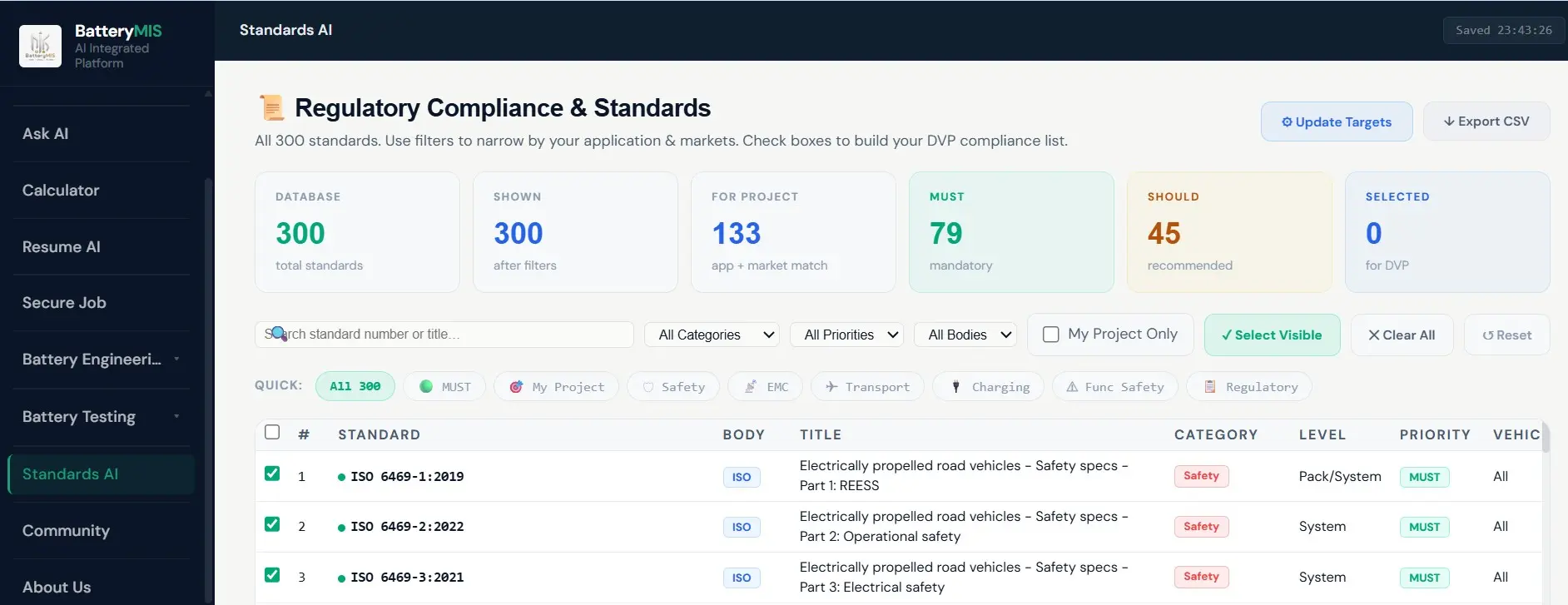
📜 Regulatory Compliance & Standards

All 300 standards. Use filters to narrow by your application & markets. Check boxes to build your DVP compliance list.

Database
300
total standards
Shown
300
after filters
For Project
-
app + market match
MUST
-
mandatory
SHOULD
-
recommended
Selected
0
for DVP
🔍
Quick:
# Standard Body Title Category Level Priority Vehicles Markets
📜
Loading 300 standards…
Loading…
🔍

Standards AI Search

RAG-powered - searches your 150 PDFs via Ollama + Chroma · Fully local · No API cost
🔍

Standards AI Search

RAG-powered search across your 150 EV battery standards · Powered by Ollama + Chroma · Fully local
Not configured
Build your question
Quick:
📚
Ask any question about your battery standards
Select filters above to narrow the search, then type your question.
The AI will search your 150 standards, find the most relevant clauses,
and give a cited answer. If a standard is not found, it will say so.
⚙ Setup required first
1. Install Docker → run Chroma
2. Install Ollama → pull nomic-embed-text + llama3
3. Import n8n workflows (download below)
4. Click ⚙ Setup → enter your webhook URLs
5. Click ▶ Run ingestion to index your PDFs

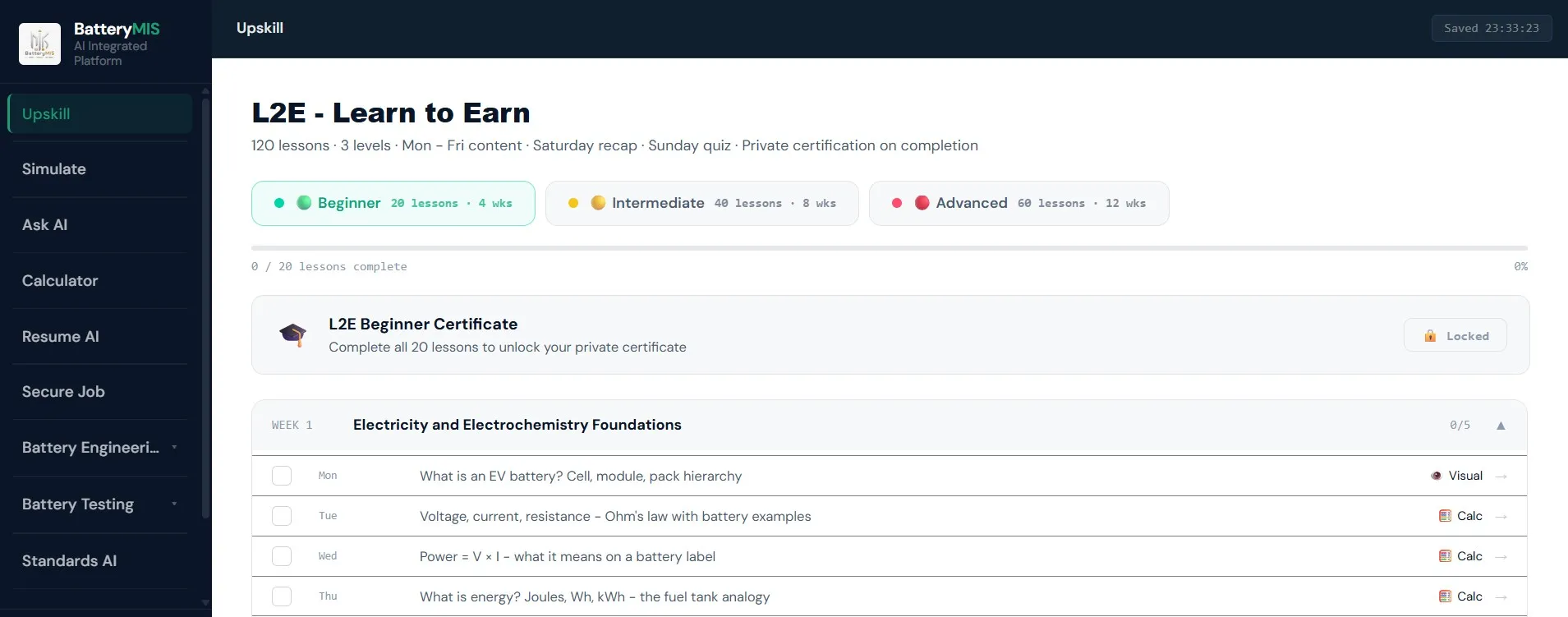
L2E — Learn to Earn

120 lessons · 3 levels · Mon–Fri content · Saturday recap · Sunday quiz · Private certification on completion
🟢 Beginner 20 lessons · 4 wks
🟡 Intermediate 40 lessons · 8 wks
🔴 Advanced 60 lessons · 12 wks
0 / 20 lessons complete 0%
🎓
L2E Beginner Certificate
Complete all 20 lessons to unlock your private certificate
Target Roles — Beginner Level
Loading lesson…
🏆
L2E Beginner Certificate
Awarded for completing all 20 lessons of the Beginner level of the L2E Battery Engineering Curriculum.
L2E-BEG-000000

Battery Learning Lab

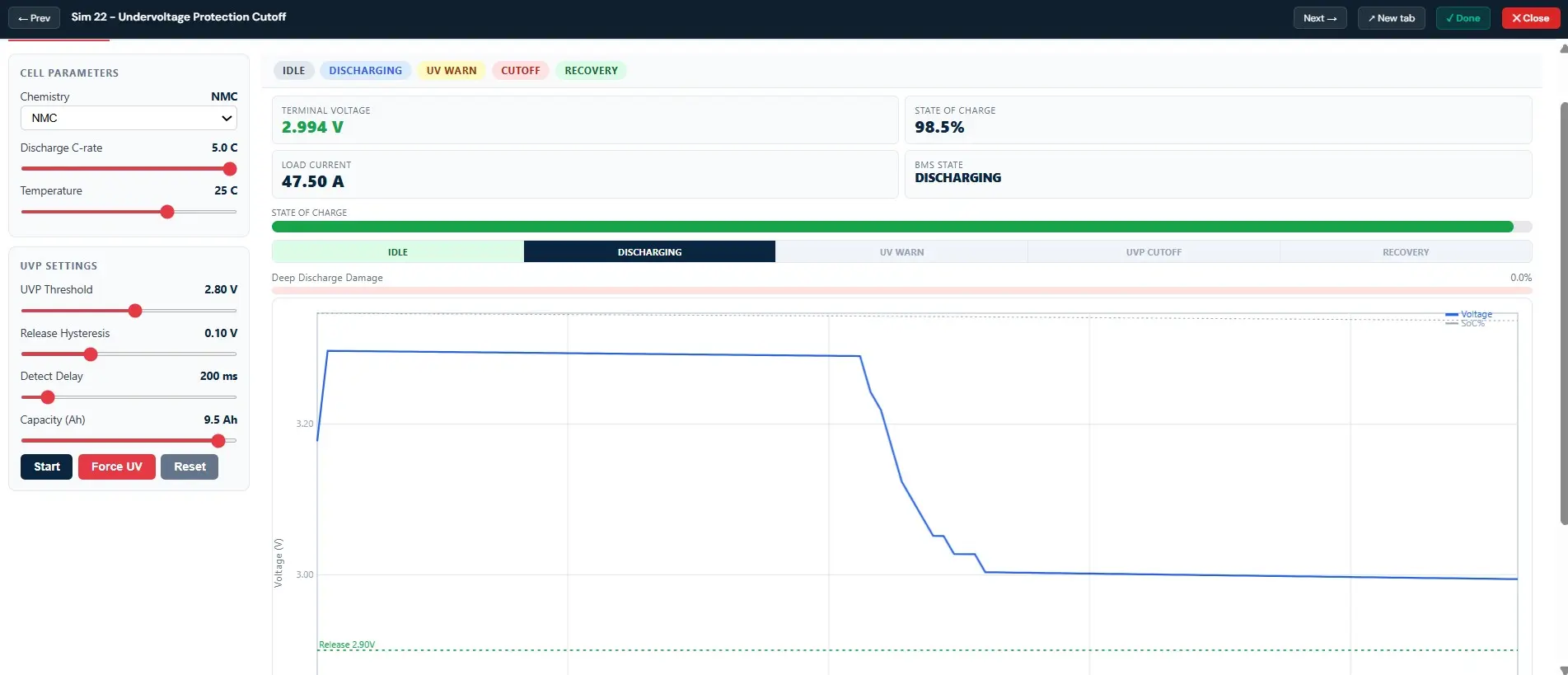
Interactive simulations for advanced battery engineering education - by Viji Venkatesan

110
Simulations
0
Completed
110
Available
All 110
Cell Fundamentals 10
Pack Architecture 10
BMS Core 10
Thermal 10
Sensing 10
Charging 10
Protection 10
Electrical 10
System Level 10
Abuse & Safety 10
Standards 10
Simulation
This simulation will be available soon.
Open in new tab when available
🧪
Click the Battery Testing tab above to load
📄

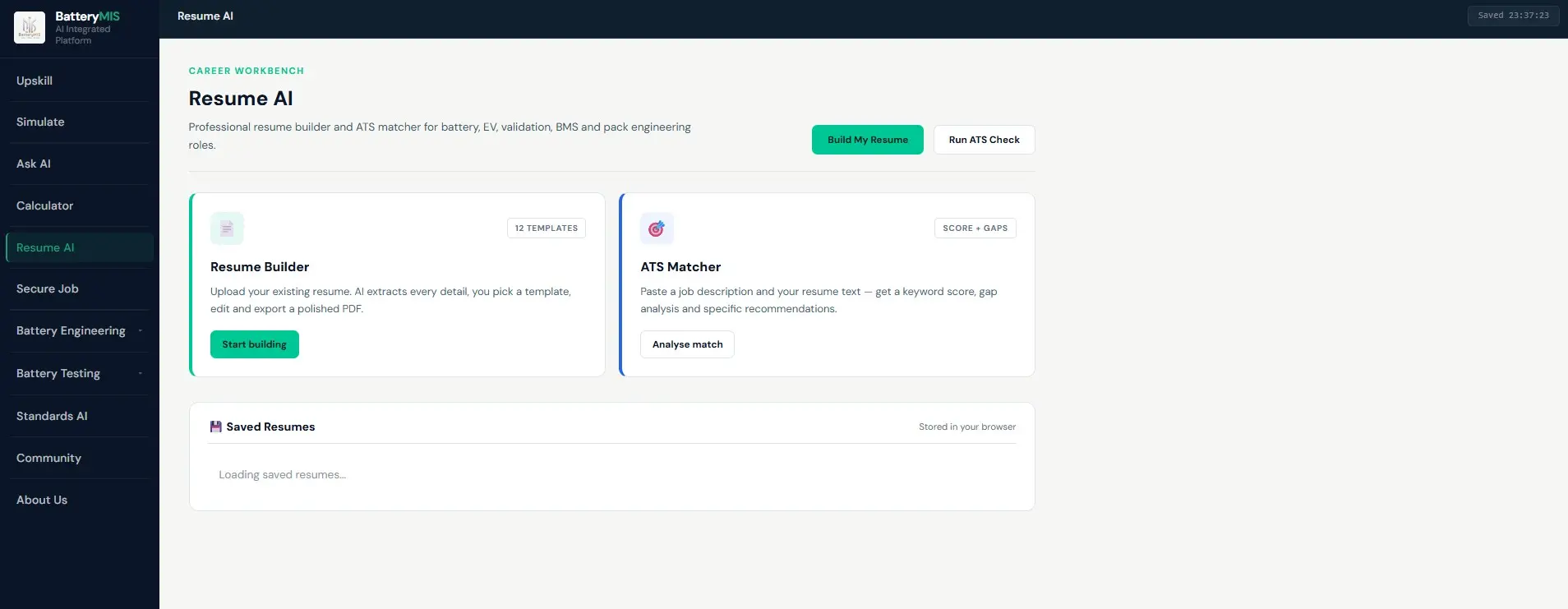
Resume AI

Loading resume builder and ATS matcher...

Select Resume AI from the sidebar to start.
🎯

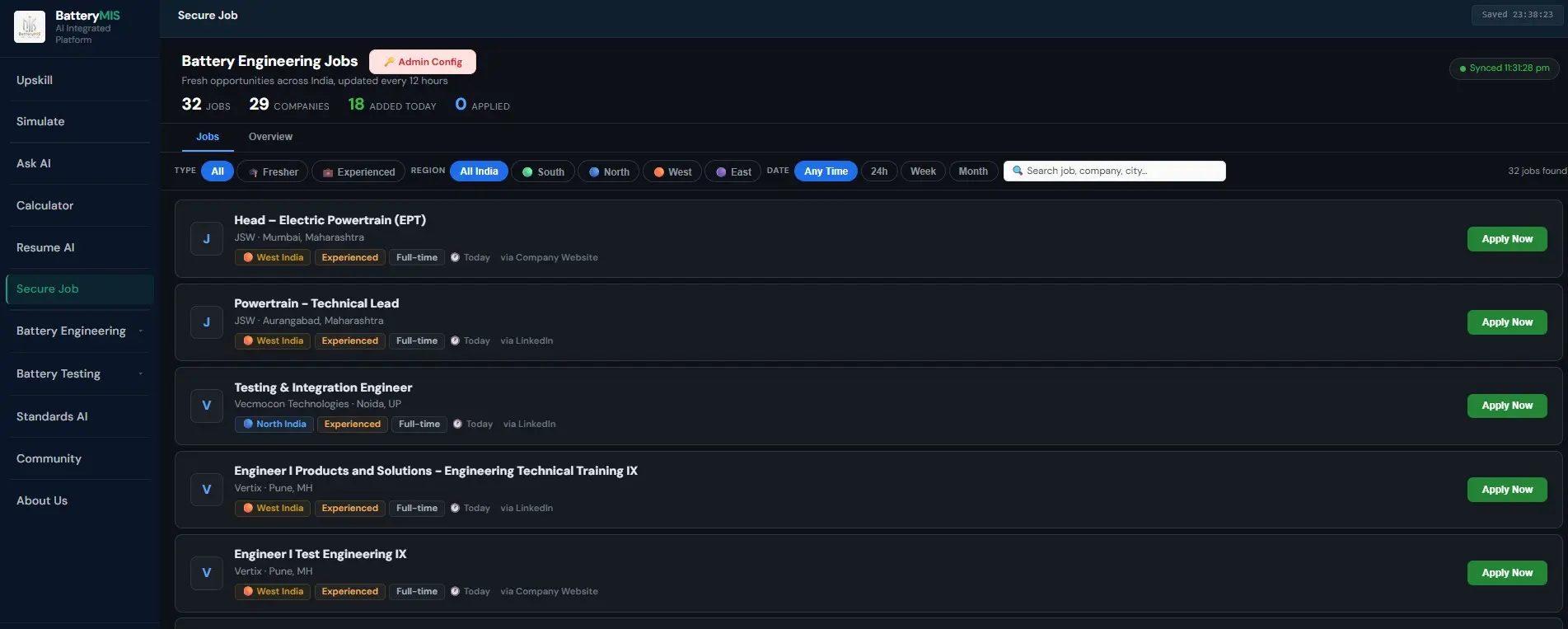
Secure Job

Job search tools, interview prep and career resources for battery engineers.

🎯
Secure Job
Coming soon - this section is under construction.

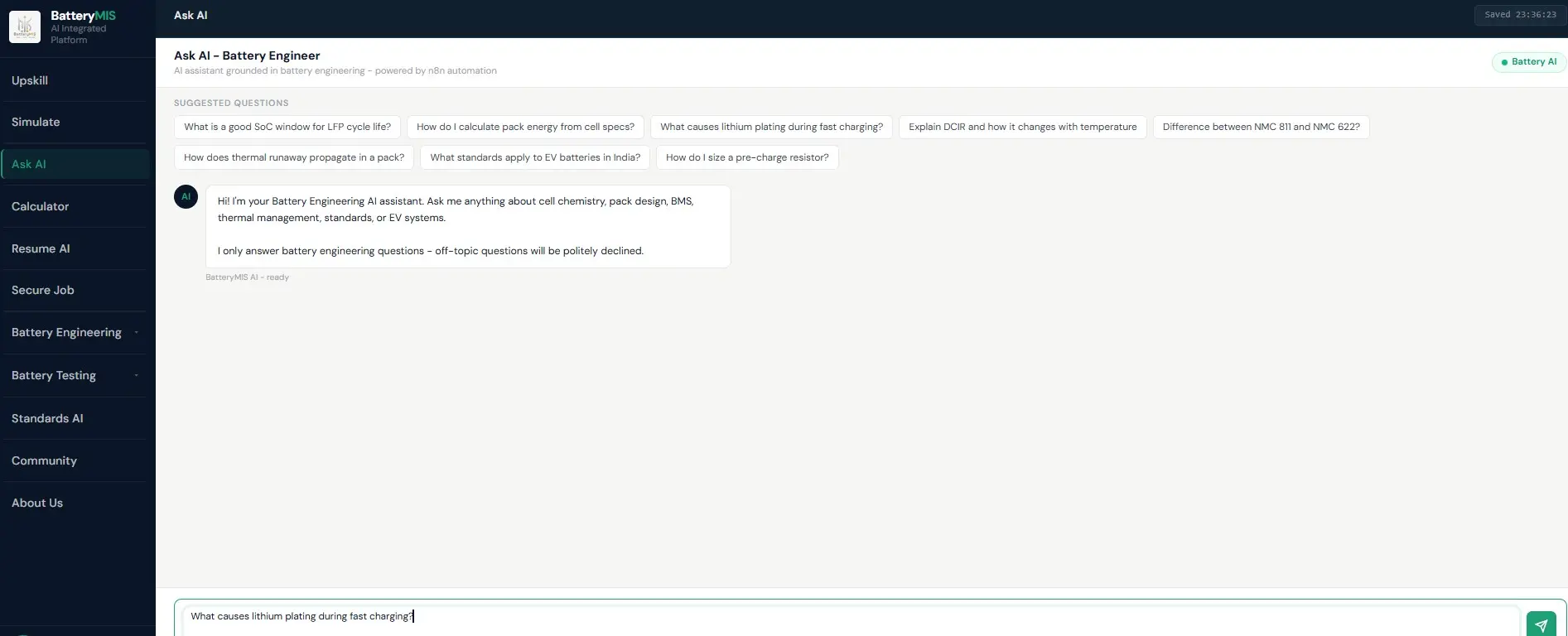
Ask AI - Battery Engineer

AI assistant grounded in battery engineering - powered by n8n automation

Battery AI
n8n Not configured

Suggested questions

What is a good SoC window for LFP cycle life?
How do I calculate pack energy from cell specs?
What causes lithium plating during fast charging?
Explain DCIR and how it changes with temperature
Difference between NMC 811 and NMC 622?
How does thermal runaway propagate in a pack?
What standards apply to EV batteries in India?
How do I size a pre-charge resistor?
AI
Hi! I'm your Battery Engineering AI assistant. Ask me anything about cell chemistry, pack design, BMS, thermal management, standards, or EV systems.

I only answer battery engineering questions - off-topic questions will be politely declined.
BatteryMIS AI - ready
ℹ️

About Us

About BatteryMIS and the team behind it.

ℹ️
About Us
Coming soon - this section is under construction.

HTOE Life Cycle Calculation - Arrhenius Thermal Acceleration Model

Battery Engineering | Acceleration Factor & Sample Size Calculator | by Viji Venkatesan

STEP 1 Input Parameters
STEP 2 Arrhenius Constants
STEP 3a Ambient Temperature Distribution
#Temp (°C)Distribution (%)AT,itfield,i (h)ttest,i (h)
TOTAL---
STEP 3b Coolant Temperature Distribution
#Temp (°C)Distribution (%)AT,i (coolant)ri/100 / AT,i
TOTAL--
STEP 4 Test Duration Results
Press Calculate to see results
STEP 5 Sample Size - Weibull / Reliability Demonstration
Press Calculate to see results
All calculations update in real-time